
The Bible repeatedly asks us to love one another (John 13:34) and live in peace and harmony with one another (Romans 15:5, Hebrews 12:14). As Christians, we know forgiveness is not an option but a command (Matthew 6:15; Mark 11:25 ) but why are we still having trouble forgiving others?
When struggling with forgiveness, this summary of a Lenten series on Forgiveness might help. But if you’re still have trouble dealing with past incidents and the pain keeps coming back when others rub on your scars, you may be trying to forgive without resolving the conflict – “Conflict Resolution” might be the missing piece in the puzzle. Conflict Resolution is often taught at organizations but I would like to customize it with Biblical references for audience outside an organizational setup (families/friends/groups etc).
Topics covered:
- Definition of Conflict
- Conflict levels
- Conflict causes
- What if conflict is not resolved?
- Conflict Management
- Conflict Resolution
What’s a conflict?
Conflict is any disagreement or hostility between two or more people in a group/organization that arises due to varied interests, values, ideas, beliefs, goals or understanding.
Traditionally, conflicts were viewed negatively as harmful and avoidable but behavioral scientists state that conflicts are natural in groups composed of individuals with different goals, values and perceptions and if resolved completely can actually bring people together.
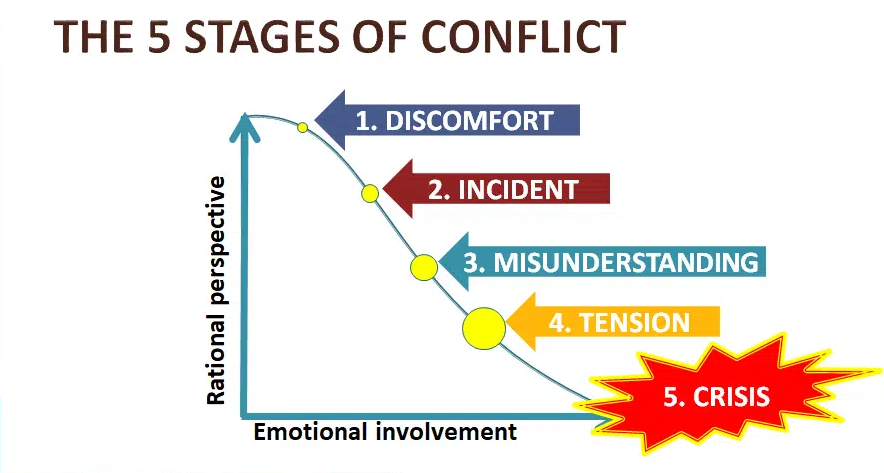

- Discomfort: In this stage, things don’t feel right but nothing is said yet. Its difficult to identify the problem at this stage.
- Incident: A short, sharp exchange occurs without any lasting reaction but leaves you upset, irritated or with a result you didn’t want.
- Misunderstanding: Motives or facts are often confused or misperceived. Your thoughts keep returning frequently to the problem.
- Tension: At this stage, relationships are weighed down by negative attitudes and fixed opinions. The way you feel about the other person has significantly changed for the worse and the relationship is a source of constant worry and concern.
- Crisis: This is when it affects behavior, normal functioning is difficult and extreme gestures are contemplated or executed. This can lead to a major events like quitting a job, rupture in relationship or violence.

Key factors that cause conflict:
According to the Bible, conflicts are caused by temper (Proverbs 15:18), greed/arrogance (Proverbs 28:25), anger (Proverbs 29:22), hatred (Proverbs 10:12), inner desires (James 4:1), stupid arguments (2 Timothy 2:23) perverseness (Proverbs 16:28, Proverbs 6:14) and in general acts of the flesh (Galatians 5:19-21).
Let’s take a look at the worldly view of the major causes of conflict :
- Differences: Often we fail to realize that no two people are like.
- People can be from different cultures, ethnicity, education, languages, nationality, religions, race etc These differences can lead to differences in values, motivations, ideas, perceptions, goals etc.
- Even in families with similar backgrounds there can be differences in backgrounds, age (generation gap), nature (soft spoken, short tempered etc), political beliefs, personality types ( Type 1 vs Type 2 personality or more different personality types), religious doctrines, etc. Another factor is that social media has brought these differences out in the open when people share views in social media that may be offensive to others.
- When people fail to understand that the other person is different and there’s not always black and White but multiple shades of grey in-between it leads to conflict.
- People differ in responding to conflict also – some want to talk it out and resolve whereas some don’t want it to escalate by talking about it and let it die on its own.
- Tolerance levels: Tolerance levels have reduced a lot in recent generations and when these people are flooded with contradictory information from various news websites/channels, Social media etc we have a new generation of people who’re very divisive and intolerant.
- Perceptions: Misunderstanding arises when people have different perceptions is a common cause of conflict. The above picture is a good example of how different people perceive the same thing/issue leading to conflict.
- Uncontrolled emotions: The book “The Happiness Hypothesis” describes The Elephant vs the rider metaphor to explain how the mind is divided into four ways and the conflict between the rational side and the emotional side. When the emotional side gets out of control, we end up having emotional outbursts, lose our temper etc leading to conflict.
- Power dynamics: Unlike organizations, power dynamics in families is often out of love (Care vs Control). Few examples are:
- Elders have conflicts with the younger generation when both think they’re right (Experience vs exposure) and expect the other person to listen to them.
- The “Head of the family” sees the other person as a threat to their status (especially when family businesses are involved).
- Lack of role clarity can lead to conflict.
- Communication Styles: Conflict arises when there is a disagreement between people with differing communication styles ( direct/functional/collaborative/influencer (or Assertive/Passive/Aggressive types) when people don’t understand or adapt to the other person’s communication style. Lack of Communication or Communication breakdown is a major cause of conflicts.
- Lack of Trust: Just like organizations, mutual trust is needed within families/groups to achieve common goals and lack of trust becomes a barrier.
- Resources/Wealth: Conflicts due to inheritance/Property issues are very common in families. Scarcity motivates people to compete with others.
- Health issues: Though this is rarely discussed, dealing with chronic or life threatening illnesses can cause conflicts within families related to decisions on treatment options, care-giving responsibilities etc especially when people are not aware of resources (or unavailability) like support groups, social workers etc.
I don’t intend to address conflict between couples in this article but there are many articles that go in-depth into such conflicts.
Why should we resolve conflicts?
Biblical reasons to resolve a conflict are:
- The Bible expects us to resolve conflicts right away, especially before giving an offering (Matthew 5:23-26, Proverbs 20:3 )
- Nobody wins in an argument/conflict except the devil. When we have a conflict we give the devil a foothold (Ephesians 4:27) and let him in to steal, kill and destroy (John 10:10) the love in our relationships.
- The Scripture clearly states that the fruit of spirit conflicts with the acts of flesh (Galatians 5:17) and should not keep envying or provoking each other (Galatians 5:26)
- You end up destroying each other (Galatians 5:15)
When conflicts are not resolved for a long time, they:
- Cause strain in relationships and even breaks them
- Cause stress that affects physical, emotional and mental health
- Stress turns into trauma after a period of time
- Slows productivity
- Affects decision making
- Improved family/group cohesion
- When we resolve conflicts we teach the younger generation about the value of relationships and to work it out when we have issues. When we fail to resolve conflicts, we set a bad example for the younger generation.
Healthy and unhealthy responses to conflict:
| Unhealthy responses | Healthy responses |
|---|---|
| Inability to recognize & respond to the other person’s view | Empathize with the other person’s viewpoint. |
| Explosive, angry, hurtful and resentful reactions | Calm, non-defensive and respectful reactions |
| The withdrawal of love, resulting in rejection, isolation, shaming, and fear of abandonment | Readiness to forgive and forget, and to move past the conflict without holding resentments or anger. |
| Inability to compromise | Ability to seek compromise and avoid punishing |
| Feeling fearful or avoiding conflict; expecting a bad outcome | A belief that facing conflict is best for both sides |
Biblical references to conflicts:
There are people who’re able to adhere to what the Scripture says (Ephesians 4:31) and put away all anger, bitterness, wrath, along with malice (Love covers over all wrongs – Prov 10:12) but not everybody is able to do it (either we don’t know how to resolve as the conflict is much more complicated or there are some who blame the other person).
The Bible talks about conflict resolution a couple of times in the New Testament (Matthew 18:15-17 and Luke 17:3-4) when the issue involves sin. When the conflict is about personality clashes, we can refer to Paul’s advice to Philippians to not look after our own interests but the interests of others (Philippians 2:3-4) and to Euodia and Syntyche “to be of the same mind in the Lord” (Philippians 4:2-3). Other than that, practical approaches to resolve conflicts are beyond the scope of the Scripture and that’s the reason, I’ve got some insights from the corporate world (Conflict Management vs Conflict Resolution and few suggestions about which one to pick).
Characteristics of Beneficial Discussions:
There are times when discussions get out of control and become arguments. Hence, I would like to iterate the characteristics of a beneficial discussion before we discuss conflict management and conflict resolutions.
- Clear emotional barriers
- Listen More Than You Speak
- Remain open-minded
- Show attentiveness
- Mind Your Body Language
- Avoid negative presuppositions
- Be Assertive, but considerate
Conflict Management:
Conflict management is the ongoing process of addressing and handling chronic issues in a relationship. It aims to minimize the negative impact of the conflict and maintain a functional relationship. Ways to deal with conflict:

- Accommodating: When accommodating (I lose and give in), you resolve the disagreement by sacrificing your own needs and desires for those of the other person. This style might benefit your work when conflicts are trivial and you need to move on quickly. This style works when your relationship is more important than being right Eg: Spouse or child. Though it leads to a peaceful atmosphere it could also lead to built-up frustrations and resentment.
- Avoiding: When avoiding, you try to dodge or bypass or withdraw from a conflict. This style of managing conflicts is low in assertiveness and cooperativeness.
- Avoidance is unproductive for handling most disputes because it may leave the other person feeling like you don’t care and some conflicts may become much more troublesome.
- However, an avoiding management style works in situations where you need time to think through, you have more pressing problems to deal with or the risks of confronting a problem outweigh the benefits (chances of winning are low).
- Collaborating: Collaborating (I win, you win) demands a high level of cooperation from all parties involved. Individuals in a dispute come together to find a respectful resolution that benefits everyone. Collaborating works best when both persons realize the need to resolve conflict.
- Competing: Also called “forcing” (I win, you lose), you put your own needs and desires over those of others (it’s the opposite of accommodating). This style is high in assertiveness and low in cooperation. This style may never be acceptable outside an organizational setup, it’s sometimes needed when you are in a higher position of power than the other person and need to resolve a dispute quickly. Eg: Manager vs employee.
- Compromising: In this style(both get something), everyone gets something they want or need (look for common ground) and demands moderate assertiveness and cooperation from everyone involved. This style of managing conflict works well when time is limited, both parties are of equal power and are willing to work hard. Because of time constraints, compromising isn’t always as creative as collaborating, and some parties may come away less satisfied than others.

Conflict Resolution:
Conflict Resolution specifically focuses on finding a permanent solution for a solvable conflict. It aims to address the root causes of the issue, find a mutually satisfactory solution to the problem, eliminate conflict, and restore harmony in the relationship.
If you’re patient enough to read this long article, it shows your intent to learn and improve your conflict management/resolution skills. Since there’s no tailor-made solution for all conflicts but they all emphasize acknowledging the problem, communicating, listening and further developing a plan to resolve conflicts. I’ll suggest a few methods and let you choose the appropriate one(s).
A couple of common strategies that can be used with any of the below methods are:
- Address the hurt: Psychologists say that when discussing conflicts, instead of blaming the other person (you did this, you did that etc), try to explain why you’re hurt and also understand the reason the other person is hurt. Also, try to think how you or the other person could have handled the situation better (statements like “If I were you, I would have done this” would help).
- Recollect good memories: Take time to recollect all the good memories that you’ve shared with the other person
- Humor: Use of humor can avoid many confrontations and resolve many disagreements/arguments. Humor can reduce anger/tension, re-frame the problem, put things into perspective and is strongly encouraged to be used in whichever method you’re following.
Conflict Resolution Strategies:
- The key steps are:
- To create the right atmosphere (characteristics of beneficial discussion discussed earlier)
- Bring clarity in perceptions (all of us have our own biases)
- Focus on shared and individual needs
- Resolve the past
- Build shared power
- Generate options and
- Make mutual agreements for resolution.
- Another method is:
- Listen carefully to both sides of the story without bias
- Focus on events & behavior but not personalities
- Identify the main points of disagreement
- Focus on one area of conflict at a time
- Create a plan to resolve conflict
- Stick to the plan.
- The third method is:
- Listen to what is said/felt (gather necessary information)
- Make maintaining/strengthening relationship priority rather than winning or “being right”
- Avoid holding on to past grudges & focus on the present
- Pick your battles & let go of issues that are not worth the time/energy/pain
- Be willing to forgive
Conflict Management vs Conflict Resolution:
Last but not the least, when do we decide if we need to manage a conflict or resolve it? Here are a few suggestions:
- Nature of conflict: Conflict Management may be suitable persistent or recurring problems
- Emotional intensity: Intense conflicts causing significant anger, tension or emotional distress may need to focus on resolving the issue.
- Relationship dynamics: When both sides are not interested to discuss the issue and resolve it, conflict management may keep things stable.
| Conflict Management | Conflict Resolution |
|---|---|
| Suitable for chronic issues | Suitable for solvable problems |
| Focuses on ongoing management | Provides a definite solution |
| Aims to minimize the damages caused by the conflict | Aims to eliminate the conflict altogether |
| Keeps relationship functional | Restores harmony to the relationship |
Closing thoughts:
Conflicts may actually be a blessing in disguise when its focused on the future, focuses on issues and brings people together. The goal of conflict resolution is unity among believers, as the devil always waits for a chance to ruin our peace and get a foothold. Remember, when the other person is not willing to resolve the conflict, forgiveness can mean “letting go of the intent to get even” and in such scenarios reconciliation may not happen.
I appeal to you, brothers, by the name of our Lord Jesus Christ, that all of you agree, and that there be no divisions among you, but that you be united in the same mind and the same judgment – 1 Cor 1:10
Finally, brothers and sisters, rejoice! Strive for full restoration, encourage one another, be of one mind, live in peace. And the God of love and peace will be with you – 2 Corinthians 13:11
References:
- https://tyonote.com/conflict/
- https://www.gotquestions.org/conflict-resolution.html
- https://www.coursera.org/articles/conflict-management
- https://www.helpguide.org/articles/relationships-communication/conflict-resolution-skills.htm
- https://www.slideshare.net/MMMTS/conflict-resolution-skills-presentation
- https://gopakumarpillai.com/conflict-management-strategies/